Braindump NSE7_SSE_AD-25 Free | NSE7_SSE_AD-25 Exam Pattern
What's more, part of that BraindumpsPrep NSE7_SSE_AD-25 dumps now are free: https://drive.google.com/open?id=14FuhxL1jlhmRHT1C6tML0IU_zAJh3Tkh
For candidates who are going to attend the exam, passing the exam is a good wish. NSE7_SSE_AD-25 exam torrent will help you to pass the exam just one time, and we are pass guaranteed and money back guaranteed if you fail the exam. We promise to refund all of your money if you fail the exam by using the NSE7_SSE_AD-25 Exam Torrent, or if you have other exam to attend, we can also replace other 2 valid exam dumps for you, at the same time you can get the update version for NSE7_SSE_AD-25 exam torrent. In addition, you can consult us if you have any questions.
Fortinet NSE7_SSE_AD-25 Exam Syllabus Topics:
| Section | Weight | Objectives |
|---|---|---|
| Identity and Access Management | 15-20% | - Policy-based access control - SSO integration with identity providers - User authentication methods - Certificate-based authentication |
| Monitoring, Logging, and Troubleshooting | 15-20% | - Performance monitoring - Log analysis and reporting - Common troubleshooting scenarios - Diagnostic commands and tools |
| FortiSASE Configuration and Administration | 25-30% | - Bandwidth and traffic management - Security profiles and policies - Tunnel mode and web proxy configurations - Initial setup and configuration |
| FortiSASE Architecture and Components | 15-20% | - FortiSASE overview and deployment models - Components: FortiGate SASE, FortiProxy, FortiClient - SASE topology and network design - Zero Trust Network Access (ZTNA) fundamentals |
| Security Services | 20-25% | - Sandbox integration - Web filtering and DNS filtering - Threat protection features - SSL inspection configuration |
>> Braindump NSE7_SSE_AD-25 Free <<
Reliable Braindump NSE7_SSE_AD-25 Free & Leading Offer in Qualification Exams & Authorized Fortinet Fortinet NSE 7 - FortiSASE 25 Enterprise Administrator
Our NSE7_SSE_AD-25 practice materials are suitable for a variety of levels of users, no matter you are in a kind of cultural level, even if you only have high cultural level, you can find in our NSE7_SSE_AD-25 study materials suitable for their own learning methods. So, for every user of our study materials are a great opportunity, a variety of types to choose from, more and more students also choose our NSE7_SSE_AD-25 Study Materials, then why are you hesitating?
Fortinet NSE 7 - FortiSASE 25 Enterprise Administrator Sample Questions (Q41-Q46):
NEW QUESTION # 41
An existing Fortinet SD-WAN customer
is reviewing the FortiSASE ordering guide to identify which add-on is needed to
allow future FortiSASE remote users to reach private resources. Which add-on
should the customer consider to allow private access? (Choose one answer)
- A. FortiSASE Branch On-Ramp add-on
- B. FortiSASE Global add-on
- C. FortiSASE SPA add-on
- D. FortiSASE Dedicated Public IP Address add-on
Answer: C
Explanation:
To enable remote users to access internal applications
located behind an existing FortiGate SD-WAN hub, the customer must license the
FortiSASE Secure Private Access (SPA) add-on.
* Secure Private Access (SPA)
Use Case: This specific add-on is designed to extend the Fortinet Security
Fabric into the SASE cloud, allowing for a hub-and-spoke architecture where the
FortiSASE PoPs act as spokes and the customer's on-premises FortiGate acts as
the hub.
* Licensing Requirements: The SPA add-on is a per-hub (per service
connection) license. It provides the necessary entitlements to establish IPsec
tunnels and BGP peering between the SASE infrastructure and the corporate
FortiGate.
* Feature Enablement: Once the SPA license is applied, the
Configuration > Private Access menu becomes available in the FortiSASE
portal. This allows administrators to define "Service Connections" to their
private data centers or cloud VPCs.
* Analysis of Other Options:
* Option
A: The Global add-on is typically related to expanding the geographic reach or
performance of the SASE PoPs, not specifically for private resource
routing.
* Option B: The Branch On-Ramp refers to connecting physical office
locations (Thin Edge) to SASE, rather than the specific licensing for private
application access for remote users.
* Option D: Dedicated Public IP Address
is used for source IP anchoring (SIA) to ensure remote users egress with a
consistent IP for third-party SaaS IP-whitelisting.
NEW QUESTION # 42
How does FortiSASE hide user
information when viewing and analyzing logs?
- A. By encrypting data using Secure Hash Algorithm 256-bit (SHA-256)
- B. By hashing data using salt
- C. By encrypting data using advanced encryption standard (AES)
- D. By hashing data using Blowfish
Answer: B
Explanation:
FortiSASE hides user information when viewing and analyzing
logs by hashing data using salt. This approach ensures that sensitive user
information is obfuscated, enhancing privacy and security.
* Hashing Data
with Salt:
* Hashing data involves converting it into a fixed-size string of
characters, which is typically a hash value.
* Salting adds random data to
the input of the hash function, ensuring that even identical inputs produce
different hash values.
* This method provides enhanced security by making it
more difficult to reverse-engineer the original data from the hash value.
*
Security and Privacy:
* Using salted hashes ensures that user information
remains secure and private when stored or analyzed in logs.
* This technique
is widely used in security systems to protect sensitive data from unauthorized
access.
References:
FortiOS 7.6 Administration Guide: Provides information
on log management and data protection techniques.
FortiSASE 23.2
Documentation: Details on how FortiSASE implements data hashing and salting to
secure user information in logs.
NEW QUESTION # 43
In a FortiSASE secure web gateway
(SWG) deployment, which two features protect against web- based threats? (Choose
two.)
- A. intrusion prevention system (IPS) for web traffic
- B. web application firewall (WAF) for web applications
- C. malware protection with sandboxing capabilities
- D. SSL deep inspection for encrypted web traffic
Answer: C,D
Explanation:
SSL deep inspection allows FortiSASE to analyze encrypted web
traffic for threats, while malware protection with sandboxing detects and blocks
malicious files delivered through web channels.
NEW QUESTION # 44
Refer to the exhibit. An organization
must inspect all the endpoint internet traffic on FortiSASE, and exclude Google
Maps traffic from the FortiSASE VPN tunnel and redirect it to the endpoint
physical interface.
Which configuration must you apply to achieve this
requirement?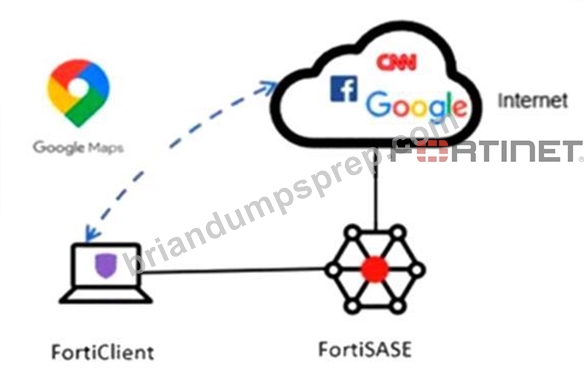
- A. Exempt Google Maps in URL filtering in the web filter profile.
- B. Add the Google Maps URL in the zero trust network access (ZTNA) TCP access proxy forwarding rule.
- C. Configure a steering bypass tunnel firewall policy using Google Maps FQDN to exclude and redirect the traffic.
- D. Add the Google Maps URL as a steering bypass destination in the endpoint profile.
Answer: D
Explanation:
To exclude specific internet traffic (such as Google Maps)
from being tunneled through FortiSASE and instead direct it out the local
endpoint interface, you must configure it as a steering bypass destination in
the FortiClient endpoint profile. This ensures traffic matching the URL bypasses
the FortiSASE tunnel.
NEW QUESTION # 45
To complete their day-to-day
operations, remote users require access to a TCP-based application that is
hosted on a private web server. Which FortiSASE deployment use case provides the
most efficient and secure method for meeting the remote users' requirements?
- A. inline-CASB
- B. SD-WAN private access
- C. zero trust network access (ZTNA) private access
- D. next generation firewall (NGFW)
Answer: C
Explanation:
Zero Trust Network Access (ZTNA) private access provides the
most efficient and secure method for remote users to access a TCP-based
application hosted on a private web server. ZTNA ensures that only authenticated
and authorized users can access specific applications based on predefined
policies, enhancing security and access control.
* Zero Trust Network Access
(ZTNA):
* ZTNA operates on the principle of "never trust, always verify,"
continuously verifying user identity and device security posture before granting
access.
* It provides secure and granular access to specific applications,
ensuring that remote users can securely access the TCP-based application hosted
on the private web server.
* Secure and Efficient Access:
* ZTNA private
access allows remote users to connect directly to the application without
needing a full VPN tunnel, reducing latency and improving performance.
* It
ensures that only authorized users can access the application, providing robust
security controls.
References:
FortiOS 7.6 Administration Guide: Provides
detailed information on ZTNA and its deployment use cases.
FortiSASE 23.2
Documentation: Explains how ZTNA can be used to provide secure access to private
applications for remote users.
NEW QUESTION # 46
......
For the Fortinet NSE 7 - FortiSASE 25 Enterprise Administrator (NSE7_SSE_AD-25) web-based practice exam no special software installation is required. because it is a browser-based Fortinet NSE 7 - FortiSASE 25 Enterprise Administrator (NSE7_SSE_AD-25) practice test. The web-based Fortinet NSE 7 - FortiSASE 25 Enterprise Administrator (NSE7_SSE_AD-25) practice exam works on all operating systems like Mac, Linux, iOS, Android, and Windows. In the same way, IE, Firefox, Opera and Safari, and all the major browsers support the web-based Fortinet NSE7_SSE_AD-25 Practice Test.
NSE7_SSE_AD-25 Exam Pattern: https://www.briandumpsprep.com/NSE7_SSE_AD-25-prep-exam-braindumps.html
- New NSE7_SSE_AD-25 Test Prep ☘ Brain NSE7_SSE_AD-25 Exam 🍌 NSE7_SSE_AD-25 Practice Exam Fee 🧑 Search for ➤ NSE7_SSE_AD-25 ⮘ and easily obtain a free download on ( www.vce4dumps.com ) 🥏Practice NSE7_SSE_AD-25 Tests
- Well-Prepared Braindump NSE7_SSE_AD-25 Free - Leader in Certification Exams Materials - Verified NSE7_SSE_AD-25 Exam Pattern ✈ Open 【 www.pdfvce.com 】 and search for 【 NSE7_SSE_AD-25 】 to download exam materials for free 🤵Practice NSE7_SSE_AD-25 Tests
- Well-Prepared Braindump NSE7_SSE_AD-25 Free - Leader in Certification Exams Materials - Verified NSE7_SSE_AD-25 Exam Pattern 🌋 Search for ➡ NSE7_SSE_AD-25 ️⬅️ and easily obtain a free download on ☀ www.exam4labs.com ️☀️ 🤿Practice NSE7_SSE_AD-25 Tests
- Online NSE7_SSE_AD-25 Training Materials 🧬 Reliable NSE7_SSE_AD-25 Test Tutorial ♣ NSE7_SSE_AD-25 Practice Exam Fee 🥻 Open website 【 www.pdfvce.com 】 and search for ( NSE7_SSE_AD-25 ) for free download 🛴NSE7_SSE_AD-25 Valid Exam Blueprint
- Prepare Your Fortinet NSE7_SSE_AD-25: Fortinet NSE 7 - FortiSASE 25 Enterprise Administrator Exam with Verified Braindump NSE7_SSE_AD-25 Free Effectively 📺 The page for free download of ⮆ NSE7_SSE_AD-25 ⮄ on { www.examcollectionpass.com } will open immediately 🐶Practice NSE7_SSE_AD-25 Tests
- 2026 100% Free NSE7_SSE_AD-25 –Trustable 100% Free Braindump Free | NSE7_SSE_AD-25 Exam Pattern 🦎 The page for free download of ▛ NSE7_SSE_AD-25 ▟ on ⏩ www.pdfvce.com ⏪ will open immediately 🌈NSE7_SSE_AD-25 Valid Exam Blueprint
- TOP Braindump NSE7_SSE_AD-25 Free - Latest Fortinet NSE7_SSE_AD-25 Exam Pattern: Fortinet NSE 7 - FortiSASE 25 Enterprise Administrator 🎌 [ www.examdiscuss.com ] is best website to obtain ☀ NSE7_SSE_AD-25 ️☀️ for free download 🦠Brain NSE7_SSE_AD-25 Exam
- Brain NSE7_SSE_AD-25 Exam 🤑 Reliable NSE7_SSE_AD-25 Test Tutorial 🦦 NSE7_SSE_AD-25 Valid Exam Blueprint 🏩 Easily obtain { NSE7_SSE_AD-25 } for free download through ▶ www.pdfvce.com ◀ 🦕Practice NSE7_SSE_AD-25 Tests
- 2026 100% Free NSE7_SSE_AD-25 –Trustable 100% Free Braindump Free | NSE7_SSE_AD-25 Exam Pattern 🔰 Search for ➠ NSE7_SSE_AD-25 🠰 and download exam materials for free through [ www.verifieddumps.com ] 🛳Dumps NSE7_SSE_AD-25 Reviews
- NSE7_SSE_AD-25 Lead2pass Review 🎐 Practice NSE7_SSE_AD-25 Tests 🥌 Real NSE7_SSE_AD-25 Dumps Free 🟧 Search for ➽ NSE7_SSE_AD-25 🢪 and easily obtain a free download on ☀ www.pdfvce.com ️☀️ 🍝NSE7_SSE_AD-25 Reliable Braindumps
- Latest NSE7_SSE_AD-25 Exam Questions Vce ❓ Reliable NSE7_SSE_AD-25 Braindumps Book 💬 NSE7_SSE_AD-25 Exams 🌁 Enter 【 www.pdfdumps.com 】 and search for ✔ NSE7_SSE_AD-25 ️✔️ to download for free 🧧NSE7_SSE_AD-25 Exams
- myportal.utt.edu.tt, myportal.utt.edu.tt, myportal.utt.edu.tt, myportal.utt.edu.tt, myportal.utt.edu.tt, myportal.utt.edu.tt, myportal.utt.edu.tt, myportal.utt.edu.tt, myportal.utt.edu.tt, myportal.utt.edu.tt, myportal.utt.edu.tt, myportal.utt.edu.tt, myportal.utt.edu.tt, myportal.utt.edu.tt, myportal.utt.edu.tt, myportal.utt.edu.tt, myportal.utt.edu.tt, myportal.utt.edu.tt, myportal.utt.edu.tt, myportal.utt.edu.tt, myportal.utt.edu.tt, myportal.utt.edu.tt, myportal.utt.edu.tt, myportal.utt.edu.tt, myportal.utt.edu.tt, myportal.utt.edu.tt, myportal.utt.edu.tt, myportal.utt.edu.tt, myportal.utt.edu.tt, myportal.utt.edu.tt, myportal.utt.edu.tt, myportal.utt.edu.tt, myportal.utt.edu.tt, myportal.utt.edu.tt, myportal.utt.edu.tt, myportal.utt.edu.tt, myportal.utt.edu.tt, myportal.utt.edu.tt, myportal.utt.edu.tt, myportal.utt.edu.tt, myportal.utt.edu.tt, myportal.utt.edu.tt, myportal.utt.edu.tt, myportal.utt.edu.tt, myportal.utt.edu.tt, myportal.utt.edu.tt, myportal.utt.edu.tt, myportal.utt.edu.tt, myportal.utt.edu.tt, myportal.utt.edu.tt, myportal.utt.edu.tt, myportal.utt.edu.tt, myportal.utt.edu.tt, myportal.utt.edu.tt, myportal.utt.edu.tt, myportal.utt.edu.tt, myportal.utt.edu.tt, myportal.utt.edu.tt, myportal.utt.edu.tt, myportal.utt.edu.tt, myportal.utt.edu.tt, myportal.utt.edu.tt, myportal.utt.edu.tt, myportal.utt.edu.tt, myportal.utt.edu.tt, myportal.utt.edu.tt, myportal.utt.edu.tt, myportal.utt.edu.tt, myportal.utt.edu.tt, myportal.utt.edu.tt, myportal.utt.edu.tt, myportal.utt.edu.tt, myportal.utt.edu.tt, myportal.utt.edu.tt, myportal.utt.edu.tt, myportal.utt.edu.tt, myportal.utt.edu.tt, myportal.utt.edu.tt, myportal.utt.edu.tt, myportal.utt.edu.tt, myportal.utt.edu.tt, myportal.utt.edu.tt, myportal.utt.edu.tt, myportal.utt.edu.tt, myportal.utt.edu.tt, myportal.utt.edu.tt, myportal.utt.edu.tt, myportal.utt.edu.tt, myportal.utt.edu.tt, myportal.utt.edu.tt, myportal.utt.edu.tt, myportal.utt.edu.tt, myportal.utt.edu.tt, myportal.utt.edu.tt, myportal.utt.edu.tt, myportal.utt.edu.tt, myportal.utt.edu.tt, myportal.utt.edu.tt, myportal.utt.edu.tt, myportal.utt.edu.tt, myportal.utt.edu.tt, myportal.utt.edu.tt, myportal.utt.edu.tt, myportal.utt.edu.tt, myportal.utt.edu.tt, myportal.utt.edu.tt, myportal.utt.edu.tt, myportal.utt.edu.tt, myportal.utt.edu.tt, myportal.utt.edu.tt, myportal.utt.edu.tt, myportal.utt.edu.tt, myportal.utt.edu.tt, myportal.utt.edu.tt, myportal.utt.edu.tt, myportal.utt.edu.tt, myportal.utt.edu.tt, myportal.utt.edu.tt, myportal.utt.edu.tt, myportal.utt.edu.tt, me.muz.li, myportal.utt.edu.tt, myportal.utt.edu.tt, myportal.utt.edu.tt, myportal.utt.edu.tt, myportal.utt.edu.tt, myportal.utt.edu.tt, myportal.utt.edu.tt, myportal.utt.edu.tt, myportal.utt.edu.tt, myportal.utt.edu.tt, myportal.utt.edu.tt, myportal.utt.edu.tt, myportal.utt.edu.tt, myportal.utt.edu.tt, myportal.utt.edu.tt, myportal.utt.edu.tt, myportal.utt.edu.tt, myportal.utt.edu.tt, myportal.utt.edu.tt, myportal.utt.edu.tt, myportal.utt.edu.tt, myportal.utt.edu.tt, myportal.utt.edu.tt, myportal.utt.edu.tt, myportal.utt.edu.tt, myportal.utt.edu.tt, myportal.utt.edu.tt, myportal.utt.edu.tt, myportal.utt.edu.tt, myportal.utt.edu.tt, myportal.utt.edu.tt, myportal.utt.edu.tt, myportal.utt.edu.tt, myportal.utt.edu.tt, myportal.utt.edu.tt, myportal.utt.edu.tt, myportal.utt.edu.tt, myportal.utt.edu.tt, myportal.utt.edu.tt, myportal.utt.edu.tt, myportal.utt.edu.tt, myportal.utt.edu.tt, myportal.utt.edu.tt, myportal.utt.edu.tt, myportal.utt.edu.tt, myportal.utt.edu.tt, myportal.utt.edu.tt, myportal.utt.edu.tt, myportal.utt.edu.tt, myportal.utt.edu.tt, myportal.utt.edu.tt, myportal.utt.edu.tt, myportal.utt.edu.tt, myportal.utt.edu.tt, myportal.utt.edu.tt, myportal.utt.edu.tt, myportal.utt.edu.tt, myportal.utt.edu.tt, myportal.utt.edu.tt, myportal.utt.edu.tt, Disposable vapes
BTW, DOWNLOAD part of BraindumpsPrep NSE7_SSE_AD-25 dumps from Cloud Storage: https://drive.google.com/open?id=14FuhxL1jlhmRHT1C6tML0IU_zAJh3Tkh


Comments
Post a Comment