OGEA-103 Valid Learning Materials | OGEA-103 Test Book
P.S. Free 2026 The Open Group OGEA-103 dumps are available on Google Drive shared by BraindumpsPrep: https://drive.google.com/open?id=1ctOibY-oitdJtjKB0zSh_nYZbshpu-KY
The third format is a web-based practice exam that is compatible with Firefox, Microsoft Edge, Safari, and Google Chrome. So the students can access it from any browser and study for The Open Group OGEA-103 Exam clarification. In addition, Mac, iOS, Windows, Linux, and Android support the web-based The Open Group OGEA-103 practice questions.
The Open Group OGEA-103 Exam Syllabus Topics:
| Section | Objectives |
|---|---|
| Enterprise Architecture Capability | - Architecture Governance
|
| Architecture Content Framework | - Content Metamodel
|
| Architecture Development Method (ADM) | - ADM Guidelines and Techniques
|
| TOGAF Standard Concepts | - TOGAF Standard Core Concepts
|
| Scenario-Based Application | - Adapting the ADM
|
| Applying TOGAF Concepts | - Architecture Building Blocks
|
| Definitions | - Key Terminology
|
>> OGEA-103 Valid Learning Materials <<
OGEA-103 Test Book & OGEA-103 Reliable Test Preparation
Our OGEA-103 study materials are willing to stand by your side and provide attentive service, and to meet the majority of customers, we sincerely recommend our study materials to all customers, for our rich experience and excellent service are more than you can imagine. There are a lot of advantages of OGEA-103 training guide for your reference. And there are three versions of different OGEA-103 exam questions for you to choose: the PDF, Soft and APP online. You can free download the demos to decide which one to choose.
The Open Group TOGAF Enterprise Architecture Combined Part 1 and Part 2 Exam Sample Questions (Q109-Q114):
NEW QUESTION # 109
Complete the sentence The purpose of
the Preliminary Phase is to_____________.
- A. identify the stakeholders and their requirements
- B. define the enterprise strategy
- C. describe the target architecture
- D. architect an Enterprise Architecture Capability
Answer: D
Explanation:
Explanation
The purpose of the Preliminary Phase is to
architect an Enterprise Architecture Capability that meets the needs and
expectations of the enterprise's stakeholders and supports and enables
subsequent phases of architecture development and transition. This phase
involves defining the scope, principles, framework, and governance for the
Enterprise Architecture Capability. Reference: The TOGAF Standard | The Open
Group Website, Section 3.2 Preliminary Phase.
NEW QUESTION # 110
Consider the following descriptions
of deliverables consumed and produced across the TOGAF ADM cycle.
General
rules and guidelines, intended to be enduring and seldom amended, that inform
and support the way in which an organization sets about fulfilling its mission
The joint agreements between development partners and sponsors on the
deliverables, quality, and fitness-for- purpose of an architecture A document
that is sent from the sponsoring organization to the architecture organization
to trigger the start of an architecture development cycle A set of quantitative
statements that outline what an implementation project must do in order to
comply with the architecture Complete the sentence. Deliverable 3 is an output
of, deliverable 4 can form:
- A. Phase A, the plan for how the architecture is governed
- B. the Preliminary Phase, a major component of an implementation project
- C. Phase A, an assessment of the changes to the architecture
- D. the Preliminary Phase, an approach to change for the Implementation and Migration Plan
Answer: A
Explanation:
Comprehensive and Detailed In-Depth Explanation from Expert
in Enterprise Architecture, guiding in TOGAF and ArchiMate:
To answer this
question correctly, it is necessary to identify the TOGAF-defined
deliverables:
Deliverable 3 is the Request for Architecture Work. This
document is formally issued by the sponsoring organization to the architecture
function to initiate a new ADM cycle or iteration.
Deliverable 4 corresponds
to Architecture Requirements, which are expressed as quantitative, testable
statements that implementation projects must satisfy to claim architectural
compliance.
Why Option A is correct:
The Request for Architecture Work is
a key output of Phase A (Architecture Vision). Phase A formally initiates the
ADM cycle, establishes scope, stakeholders, constraints, and secures approval to
proceed.
Architecture Requirements form a critical input to Architecture
Governance, specifically contributing to the plan for how the architecture is
governed, including compliance assessments, checkpoints, and governance controls
during implementation.
Why the other options are incorrect:
B). Phase A,
an assessment of the changes to the architecture: Impact and change assessments
are not the primary formation purpose of Architecture Requirements.
C). the
Preliminary Phase, an approach to change for the Implementation and Migration
Plan: The Request for Architecture Work is not produced in the Preliminary
Phase; that phase focuses on establishing Architecture Capability.
D). the
Preliminary Phase, a major component of an implementation project: Architecture
Requirements guide implementation but are not classified as a "major component"
of the project itself.
Authoritative TOGAF References:
TOGAF ADM Phase A -
Architecture Vision (Request for Architecture Work) TOGAF Architecture
Requirements Management TOGAF Architecture Governance Framework
NEW QUESTION # 111
Consider the following ADM phases
objectives.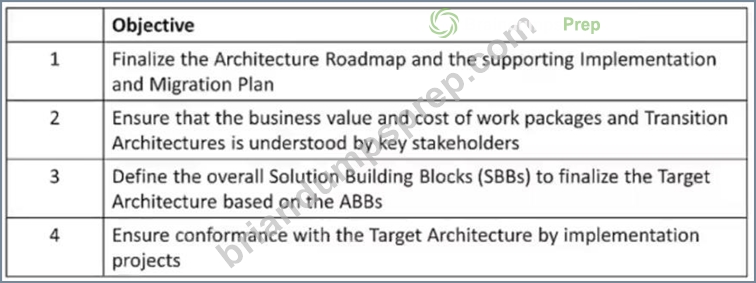
Which
phase does each objective match?
- A. 1F-2F-3E-4G
- B. 1E-2F-3E-4G
- C. 1G-2E-3F-4E
- D. 1F-2G-3F-4F
Answer: B
Explanation:
Explanation
1E: To identify delivery vehicles (projects
programs portfolios) that will deliver the Target Architecture 2F:
To confirm
readiness and ability to undergo change 3E: To determine whether an incremental
approach is required and if so identify Transition Architectures that will
deliver continuous business value 4G: To perform appropriate governance
functions while the solution is being implemented Reference: The TOGAF Standard
| The Open Group Website, Section 3.2 ADM Phases.
NEW QUESTION # 112
What can architects present to
stakeholders to extract hidden agendas, principles, and requirements that could
impact the final Target Architecture?
- A. Alternatives and Trade-offs
- B. Solutions and Applications
- C. Architecture Views and Architecture Viewpoints
- D. Business Scenarios and Business Models
Answer: C
Explanation:
According to the TOGAF Standard, Version 9.2, an architecture
view is a representation of a system from the perspective of a related set of
concerns1. It consists of one or more architecture models that demonstrate how
the system addresses the stakeholder concerns1.
An architecture viewpoint is
a specification of the conventions for constructing and using an architecture
view to address specific stakeholder concerns1. It defines the perspective,
scope, notation, and techniques for creating an architecture view of a
system1.
Architects can present architecture views and viewpoints to
stakeholders to extract hidden agendas, principles, and requirements that could
impact the final Target Architecture, because23:
Architecture views and
viewpoints help to communicate and visualize the architecture in a way that is
meaningful and relevant to different stakeholders, addressing their specific
interests and needs.
Architecture views and viewpoints help to elicit and
validate the stakeholder concerns and requirements, ensuring that they are
aligned with the business goals and objectives, and that they are consistent and
feasible within the architecture context.
Architecture views and viewpoints
help to identify and resolve any conflicts, gaps, or trade-offs among the
stakeholder concerns and requirements, ensuring that they are balanced and
prioritized in the architecture design and decision-making.
Architecture
views and viewpoints help to demonstrate and verify the value and benefits of
the architecture to the stakeholders, ensuring that they are satisfied and
committed to the architecture outcome and governance.
Reference:
1: The
TOGAF Standard, Version 9.2, Chapter 22: Architecture Views, Viewpoints, and
Stakeholders
2: The TOGAF Standard, Version 9.2, Chapter 4: Introduction to
Part II, Section 4.2: What is an Architecture Framework?
3: The TOGAF
Standard, Version 9.2, Chapter 31: Architectural Artifacts, Section 31.1: Basic
Concepts
NEW QUESTION # 113
Consider the illustration.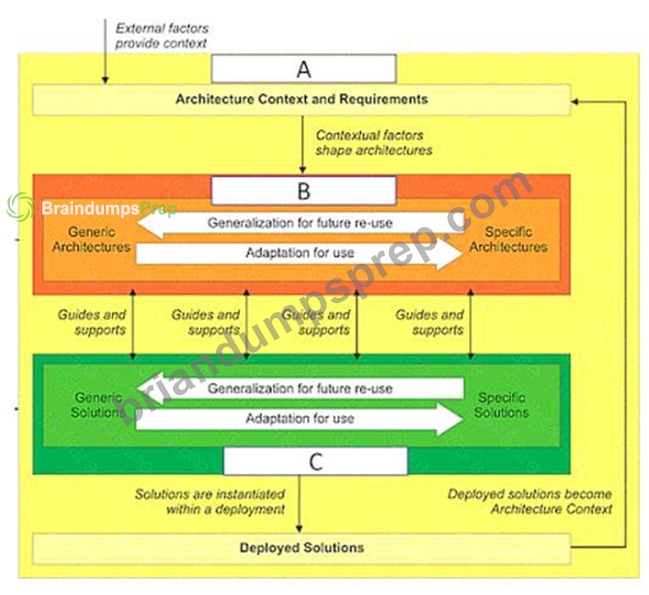
What
are the items labelled A, B and C?
- A. A-Architecture Vision, B-Business Architecture, C-Information Systems Architecture
- B. A-Enterprise Architecture, B-Architecture Building Blocks, C-Solutions Building Blocks
- C. A-Enterprise Strategic Architecture, B-Segment Architecture, C-Solutions Architecture
- D. A-Enterprise Continuum, B-Architecture Continuum, C-Solutions Continuum
Answer: D
Explanation:
The illustration shows the relationship between the
Enterprise Continuum, the Architecture Continuum, and the Solutions Continuum,
which are key concepts in the TOGAF framework. The Enterprise Continuum is a
view of the Architecture Repository that shows how generic foundation
architectures can be leveraged and specialized to support the requirements of an
individual organization. The Architecture Continuum specifies a structured
classification for architectural artifacts, such as models, patterns, and
descriptions, that can be reused and adapted across different domains and levels
of abstraction. The Solutions Continuum identifies implemented solutions that
support various stages of business and IT capability evolution, such as common
systems, industry solutions, and organization-specific solutions. The
illustration also shows how the architecture context and requirements are
influenced by external factors, such as business drivers, stakeholders, and
standards, and how they shape the generic and specific architectures and
solutions. The illustration also shows how the deployed solutions become part of
the architecture context for future iterations of the architecture development
cycle. References:
*TOGAF Standard, 10th Edition, Part II: Architecture
Development Method, Chapter 6: Architecture Repository, Section 6.2 Enterprise
Continuum.
*TOGAF Standard, 10th Edition, Part IV: Architecture Content
Framework, Chapter 35: Enterprise Continuum and Tools, Section 35.1
Introduction.
NEW QUESTION # 114
......
We don't want you to prepare and practice the old questions and waste time. Therefore, our team of certified experts includes updated TOGAF Enterprise Architecture Combined Part 1 and Part 2 Exam OGEA-103 Exam Questions as soon as they are released. BraindumpsPrep provides up-to-date The Open Group exam questions.
OGEA-103 Test Book: https://www.briandumpsprep.com/OGEA-103-prep-exam-braindumps.html
- 2026 Efficient OGEA-103 – 100% Free Valid Learning Materials | TOGAF Enterprise Architecture Combined Part 1 and Part 2 Exam Test Book 🥻 Search for [ OGEA-103 ] and download it for free immediately on 「 www.pass4test.com 」 🤬Valid OGEA-103 Learning Materials
- Latest OGEA-103 Test Preparation 🥾 OGEA-103 Latest Test Bootcamp 🌹 Actual OGEA-103 Test Pdf 🖕 Copy URL ▷ www.pdfvce.com ◁ open and search for ⇛ OGEA-103 ⇚ to download for free ⓂOGEA-103 Valid Study Questions
- OGEA-103 Latest Test Bootcamp 🏜 Valid Test OGEA-103 Vce Free 🧢 New OGEA-103 Exam Question 😧 Download [ OGEA-103 ] for free by simply searching on ✔ www.examcollectionpass.com ️✔️ 🏅Latest OGEA-103 Test Preparation
- OGEA-103 Valid Study Notes ⏪ OGEA-103 Official Cert Guide 🍼 OGEA-103 Certification Dump 🥳 Search for ☀ OGEA-103 ️☀️ and download exam materials for free through { www.pdfvce.com } 🎭Valid OGEA-103 Learning Materials
- New OGEA-103 Exam Question 👲 Valid OGEA-103 Learning Materials 🔰 OGEA-103 Free Exam Dumps 🛢 Go to website { www.validtorrent.com } open and search for ✔ OGEA-103 ️✔️ to download for free 🤥OGEA-103 Passguide
- Latest OGEA-103 Test Preparation 🛅 Latest OGEA-103 Test Preparation 🚰 OGEA-103 PDF Download 🤮 Search for 《 OGEA-103 》 and easily obtain a free download on ( www.pdfvce.com ) 🤼OGEA-103 Official Cert Guide
- The Open Group OGEA-103 Web-Based Practice Exam - Reliable Online Self-Assessment Test 🐯 Search for [ OGEA-103 ] on ▷ www.practicevce.com ◁ immediately to obtain a free download 🌋OGEA-103 Valid Study Notes
- Exam OGEA-103 Torrent 🧺 Valid OGEA-103 Learning Materials 💔 OGEA-103 Passguide ▶ Search for ⮆ OGEA-103 ⮄ and obtain a free download on ➠ www.pdfvce.com 🠰 🦨Latest OGEA-103 Test Preparation
- Updated OGEA-103 Practice Exams for Self-Assessment (Web-Based ) 🌙 Search for ▶ OGEA-103 ◀ and easily obtain a free download on { www.validtorrent.com } 🧘Reliable OGEA-103 Test Testking
- 2026 The Best The Open Group OGEA-103 Valid Learning Materials 🌹 The page for free download of ➤ OGEA-103 ⮘ on 《 www.pdfvce.com 》 will open immediately 🌂OGEA-103 PDF Download
- 2026 The Best The Open Group OGEA-103 Valid Learning Materials 🤘 Easily obtain free download of 《 OGEA-103 》 by searching on ⮆ www.examcollectionpass.com ⮄ 🦌OGEA-103 Free Exam Dumps
- justpaste.me, myportal.utt.edu.tt, myportal.utt.edu.tt, myportal.utt.edu.tt, myportal.utt.edu.tt, myportal.utt.edu.tt, myportal.utt.edu.tt, myportal.utt.edu.tt, myportal.utt.edu.tt, myportal.utt.edu.tt, myportal.utt.edu.tt, myportal.utt.edu.tt, myportal.utt.edu.tt, myportal.utt.edu.tt, myportal.utt.edu.tt, myportal.utt.edu.tt, myportal.utt.edu.tt, myportal.utt.edu.tt, myportal.utt.edu.tt, myportal.utt.edu.tt, myportal.utt.edu.tt, myportal.utt.edu.tt, myportal.utt.edu.tt, myportal.utt.edu.tt, myportal.utt.edu.tt, myportal.utt.edu.tt, myportal.utt.edu.tt, myportal.utt.edu.tt, myportal.utt.edu.tt, myportal.utt.edu.tt, myportal.utt.edu.tt, myportal.utt.edu.tt, myportal.utt.edu.tt, myportal.utt.edu.tt, myportal.utt.edu.tt, myportal.utt.edu.tt, myportal.utt.edu.tt, myportal.utt.edu.tt, myportal.utt.edu.tt, myportal.utt.edu.tt, myportal.utt.edu.tt, myportal.utt.edu.tt, myportal.utt.edu.tt, myportal.utt.edu.tt, myportal.utt.edu.tt, myportal.utt.edu.tt, myportal.utt.edu.tt, myportal.utt.edu.tt, myportal.utt.edu.tt, myportal.utt.edu.tt, myportal.utt.edu.tt, myportal.utt.edu.tt, myportal.utt.edu.tt, myportal.utt.edu.tt, myportal.utt.edu.tt, myportal.utt.edu.tt, myportal.utt.edu.tt, myportal.utt.edu.tt, myportal.utt.edu.tt, myportal.utt.edu.tt, myportal.utt.edu.tt, anoj.in.net, pixabay.com, myportal.utt.edu.tt, myportal.utt.edu.tt, myportal.utt.edu.tt, myportal.utt.edu.tt, myportal.utt.edu.tt, myportal.utt.edu.tt, myportal.utt.edu.tt, myportal.utt.edu.tt, myportal.utt.edu.tt, myportal.utt.edu.tt, myportal.utt.edu.tt, myportal.utt.edu.tt, myportal.utt.edu.tt, myportal.utt.edu.tt, myportal.utt.edu.tt, myportal.utt.edu.tt, myportal.utt.edu.tt, myportal.utt.edu.tt, myportal.utt.edu.tt, myportal.utt.edu.tt, annualeventpost.com, telegra.ph, rare-books.library.sites.carleton.edu, Disposable vapes
DOWNLOAD the newest BraindumpsPrep OGEA-103 PDF dumps from Cloud Storage for free: https://drive.google.com/open?id=1ctOibY-oitdJtjKB0zSh_nYZbshpu-KY


Comments
Post a Comment