The Open Group OGEA-101 PDF Format which has 100% correct answers
What's more, part of that BraindumpsPrep OGEA-101 dumps now are free: https://drive.google.com/open?id=1nG57i68NgInyeuJPexRy4diZ6OvflWkL
The The Open Group OGEA-101 exam questions are being offered in three different formats. These formats are OGEA-101 PDF dumps files, desktop practice test software, and web-based practice test software. All these three OGEA-101 exam dumps formats contain the Real OGEA-101 Exam Questions that assist you in your TOGAF Enterprise Architecture Part 1 Exam practice exam preparation and finally, you will be confident to pass the final The Open Group OGEA-101 exam easily.
The Open Group OGEA-101 Exam Syllabus Topics:
| Topic | Details |
|---|---|
| Topic 1 |
|
| Topic 2 |
|
| Topic 3 |
|
| Topic 4 |
|
| Topic 5 |
|
| Topic 6 |
|
| Topic 7 |
|
>> OGEA-101 Reliable Exam Labs <<
New OGEA-101 Braindumps Questions - OGEA-101 Test Centres
Among all marketers who actively compete to win customers, we sincerely offer help for exam candidates like you with our OGEA-101 exam questions. To cater to the needs of exam candidates, our experts have been assiduously worked for their quality day and night. OGEA-101 Training Materials can help you achieve personal goals about the OGEA-101 exam successfully. So of course we received sincere feed-backs from exam candidates which are maximum benefits for us.
The Open Group TOGAF Enterprise Architecture Part 1 Exam Sample Questions (Q57-Q62):
NEW QUESTION # 57
Exhibit: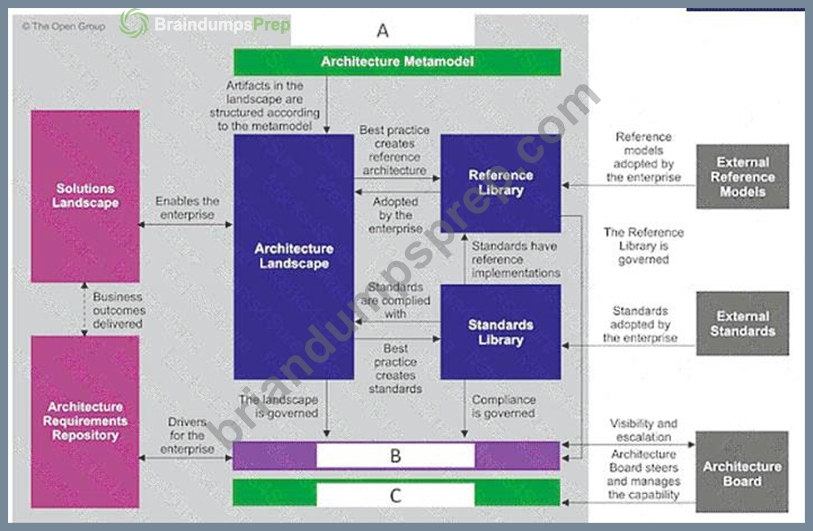
Consider
the illustration. What are the items labelled A, B, and C?
- A. A-Architecture Repository, B-Governance Repository, C-Architecture Capability
- B. A-Architecture Repository, B-Governing Board, C-Enterprise Capability
- C. A-Enterprise Repository, B-Governance Repository, C-Board Repository
- D. A-Enterprise Repository, B-Board repository, C-Enterprise Capability
Answer: B
Explanation:
A-Architecture Repository: This is a part of the Architecture
Metamodel that contains artifacts structured according to the metamodel. It
includes the Architecture Landscape which is adopted by the enterprise and
governed by certain standards and practices.
B-Governing Board: The Governing
Board ensures visibility and escalation, meaning it oversees and manages the
capability of the architecture landscape. It plays a crucial role in
governance.
C-Enterprise Capability: This refers to how well an enterprise
can execute its mission, meet business objectives or satisfy its stakeholders'
needs and expectations. It's influenced by both internal factors (like
resources, processes) and external ones (like market trends).
TOGAF Version
9.1, Chapter 34: 1
NEW QUESTION # 58
Which of the following best describes
the class of information known as the Reference Library within the Architecture
Repository?
- A. A record of the governance activity across the enterprise
- B. Guidelines and templates used to create new architectures
- C. Specifications to which architectures must conform
- D. Processes to support governance of the Architecture Repository
Answer: B
Explanation:
The class of information known as the Reference Library
within the Architecture Repository contains guidelines and templates used to
create new architectures. The Reference Library provides a set of resources that
can be leveraged or customized for specific architecture development purposes.
It includes generic building blocks, patterns, models, standards, frameworks,
methods, techniques, best practices, etc. Reference: The TOGAF Standard | The
Open Group Website, Section 2.4 Architecture Repository.
NEW QUESTION # 59
Exhibit: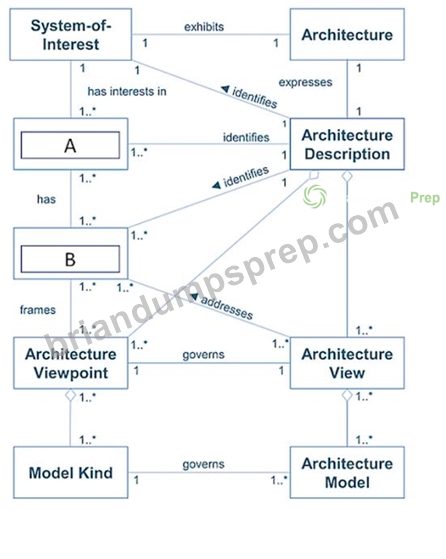
Consider
the image showing basic architectural concepts.
What are items A and B?
- A. A-User, B-Requirement
- B. A-Stakeholder, B-Concern
- C. A-Base Architecture, B-Target Architecture
- D. A-Candidate Architecture, B-Trade-off
Answer: B
Explanation:
In the context of TOGAF, a stakeholder is any individual,
team, or organization who has interests in, or concerns relative to, the outcome
of the architecture. Concerns are those interests which pertain to any aspect of
the system's functioning, development or operation, including considerations
such as performance, reliability, and security1. Reference:
* The TOGAF
Standard, Version 9.2 - Definitions - The Open Group
NEW QUESTION # 60
Consider the following ADM phases
objectives.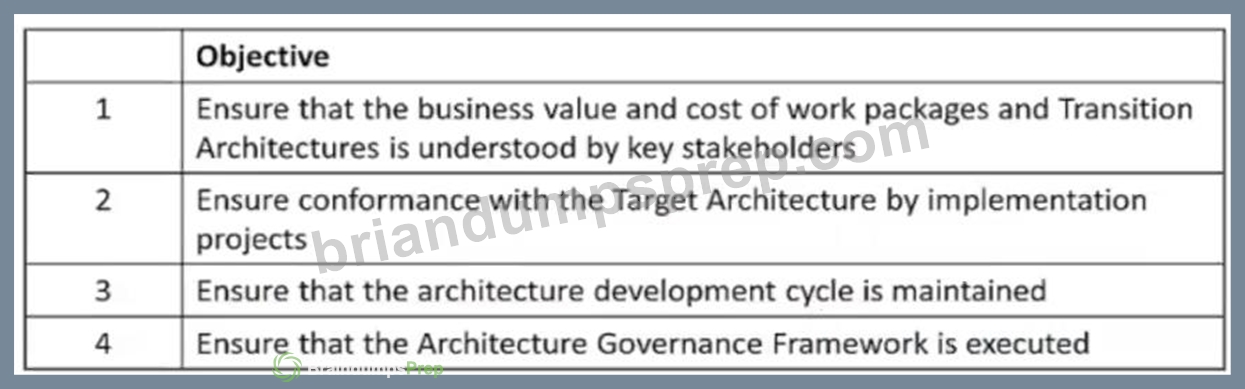
Which
phase does each objective match?
- A. 1H-2F-3F-4G
- B. 1G-2H-3H-4F
- C. 1F-2G-3G-4H
- D. 1F-2G-3H-4H
Answer: A
Explanation:
According to the TOGAF Standard, Version 9.2, the ADM phases
and their objectives are as follows1:
Preliminary Phase: To prepare and
initiate the architecture development cycle, including defining the architecture
framework, principles, and governance.
Phase A: Architecture Vision: To
define the scope, vision, and stakeholders of the architecture initiative, and
to obtain approval to proceed.
Phase B: Business Architecture: To describe
the baseline and target business architecture, and to identify the gaps between
them.
Phase C: Information Systems Architectures: To describe the baseline
and target data and application architectures, and to identify the gaps between
them.
Phase D: Technology Architecture: To describe the baseline and target
technology architecture, and to identify the gaps between them.
Phase E:
Opportunities and Solutions: To identify and evaluate the opportunities and
solutions for implementing the target architecture, and to define the work
packages and transition architectures.
Phase F: Migration Planning: To
finalize the implementation and migration plan, and to ensure alignment with the
enterprise portfolio and project management.
Phase G: Implementation
Governance: To provide architecture oversight and guidance for the
implementation projects, and to manage any architecture change
requests.
Phase H: Architecture Change Management: To monitor the changes in
the business and technology environment, and to assess the impact and
performance of the architecture.
Requirements Management: To manage the
architecture requirements throughout the ADM cycle, and to ensure alignment with
the business requirements.
Based on the above definitions, we can match each
objective with the corresponding phase as follows:
Objective 1: Ensure that
the business value and cost of work packages and transition architectures is
understood by key stakeholders. This objective is achieved in Phase H:
Architecture Change Management, where the value realization and cost-benefit
analysis of the architecture are performed2.
Objective 2: Ensure conformance
with the Target Architecture by implementation projects. This objective is
achieved in Phase F: Migration Planning, where the conformance requirements and
criteria for the implementation projects are defined3.
Objective 3: Ensure
that the architecture development cycle is maintained. This objective is
achieved in Phase F: Migration Planning, where the architecture roadmap and
iteration cycle are maintained3.
Objective 4: Ensure that the Architecture
Governance Framework is executed. This objective is achieved in Phase G:
Implementation Governance, where the architecture governance processes and
procedures are applied to the implementation projects4.
Reference:
1: The
TOGAF Standard, Version 9.2, Chapter 5: Architecture Development Method
(ADM)
2: The TOGAF Standard, Version 9.2, Chapter 21: Architecture Change
Management
3: The TOGAF Standard, Version 9.2, Chapter 20: Migration
Planning
4: The TOGAF Standard, Version 9.2, Chapter 19: Implementation
Governance
NEW QUESTION # 61
Which ADM Phase provides architectural
oversight of the implementation?
- A. Preliminary
- B. Phase A
- C. Phase H
- D. Phase G
Answer: D
Explanation:
* Phase G: Implementation Governance provides architectural
oversight of the implementation. It ensures that the implementation conforms to
the Target Architecture using Architecture Contracts and governance
frameworks.
* Phase H: Architecture Change Management is about maintaining
the architecture lifecycle and handling new requirements, not direct
implementation oversight.
* Preliminary Phase is about setting up the
architecture capability.
* Phase A is about developing the Architecture
Vision.
Reference: TOGAF Standard, Version 9.2, Part II: ADM, Phase
G.
NEW QUESTION # 62
......
This is a printable OGEA-101 PDF dumps file. The OGEA-101 PDF dumps enables you to study without any device, as it is a portable and easily shareable format, thus you can study OGEA-101 dumps on your preferred smart device such as your smartphone or in hard copy format. Once downloaded from the website, you can easily study from the The Open Group OGEA-101 Exam Questions compiled by our highly experienced professionals as directed by the The Open Group exam syllabus.
New OGEA-101 Braindumps Questions: https://www.briandumpsprep.com/OGEA-101-prep-exam-braindumps.html
- Pass Guaranteed Quiz The Open Group - OGEA-101 - Fantastic TOGAF Enterprise Architecture Part 1 Exam Reliable Exam Labs 🏓 Go to website ⇛ www.troytecdumps.com ⇚ open and search for 「 OGEA-101 」 to download for free 🥉OGEA-101 PDF Question
- Exam OGEA-101 Details 📮 Pdf OGEA-101 Torrent 🔃 Study OGEA-101 Test 😘 Search for ( OGEA-101 ) on [ www.pdfvce.com ] immediately to obtain a free download 🕊Test OGEA-101 King
- OGEA-101 Cost Effective Dumps 💾 OGEA-101 PDF Question 🙄 Pdf OGEA-101 Torrent 🦂 Copy URL 「 www.testkingpass.com 」 open and search for ⏩ OGEA-101 ⏪ to download for free ⌛Study OGEA-101 Test
- Updated The Open Group Reliable Exam Labs – High Pass Rate New OGEA-101 Braindumps Questions 💅 ▷ www.pdfvce.com ◁ is best website to obtain ➽ OGEA-101 🢪 for free download 😢Valid OGEA-101 Test Preparation
- Valid OGEA-101 Test Preparation 🍆 OGEA-101 Book Pdf ⏏ OGEA-101 Guide Torrent 👧 Search for { OGEA-101 } on ⏩ www.prepawaypdf.com ⏪ immediately to obtain a free download 🚘OGEA-101 Exam Topics Pdf
- OGEA-101 Valid Test Prep ℹ OGEA-101 Cost Effective Dumps 💋 OGEA-101 Exam Dumps ☂ Search on ▛ www.pdfvce.com ▟ for [ OGEA-101 ] to obtain exam materials for free download 🧸OGEA-101 PDF Question
- Pass Guaranteed The Open Group - OGEA-101 - TOGAF Enterprise Architecture Part 1 Exam Authoritative Reliable Exam Labs 🕒 Search on “ www.testkingpass.com ” for ( OGEA-101 ) to obtain exam materials for free download 🥏Test OGEA-101 King
- Latest OGEA-101 Dumps Ebook 🤫 New Soft OGEA-101 Simulations 🔖 OGEA-101 Guide Torrent 👶 Immediately open ( www.pdfvce.com ) and search for ➡ OGEA-101 ️⬅️ to obtain a free download 👠Study OGEA-101 Demo
- Quiz The Open Group - Accurate OGEA-101 Reliable Exam Labs ⚫ Open ➠ www.troytecdumps.com 🠰 and search for ✔ OGEA-101 ️✔️ to download exam materials for free 🎴OGEA-101 Valid Test Prep
- Fantastic OGEA-101 Reliable Exam Labs - Free PDF New OGEA-101 Braindumps Questions - Top The Open Group TOGAF Enterprise Architecture Part 1 Exam 🦛 The page for free download of ➽ OGEA-101 🢪 on ➡ www.pdfvce.com ️⬅️ will open immediately 🧛OGEA-101 Guide Torrent
- Every Area covered OGEA-101 Tested Material 🎪 Open ➠ www.troytecdumps.com 🠰 and search for ⮆ OGEA-101 ⮄ to download exam materials for free 💙New Soft OGEA-101 Simulations
- myportal.utt.edu.tt, myportal.utt.edu.tt, myportal.utt.edu.tt, myportal.utt.edu.tt, myportal.utt.edu.tt, myportal.utt.edu.tt, myportal.utt.edu.tt, myportal.utt.edu.tt, myportal.utt.edu.tt, myportal.utt.edu.tt, myportal.utt.edu.tt, myportal.utt.edu.tt, myportal.utt.edu.tt, myportal.utt.edu.tt, myportal.utt.edu.tt, myportal.utt.edu.tt, myportal.utt.edu.tt, myportal.utt.edu.tt, myportal.utt.edu.tt, myportal.utt.edu.tt, scalar.usc.edu, myportal.utt.edu.tt, myportal.utt.edu.tt, myportal.utt.edu.tt, myportal.utt.edu.tt, myportal.utt.edu.tt, myportal.utt.edu.tt, myportal.utt.edu.tt, myportal.utt.edu.tt, myportal.utt.edu.tt, myportal.utt.edu.tt, myportal.utt.edu.tt, myportal.utt.edu.tt, myportal.utt.edu.tt, myportal.utt.edu.tt, myportal.utt.edu.tt, myportal.utt.edu.tt, myportal.utt.edu.tt, myportal.utt.edu.tt, myportal.utt.edu.tt, myportal.utt.edu.tt, mahsaamini5421.blogspot.com, myportal.utt.edu.tt, myportal.utt.edu.tt, myportal.utt.edu.tt, myportal.utt.edu.tt, myportal.utt.edu.tt, myportal.utt.edu.tt, myportal.utt.edu.tt, myportal.utt.edu.tt, myportal.utt.edu.tt, myportal.utt.edu.tt, myportal.utt.edu.tt, myportal.utt.edu.tt, myportal.utt.edu.tt, myportal.utt.edu.tt, myportal.utt.edu.tt, myportal.utt.edu.tt, myportal.utt.edu.tt, myportal.utt.edu.tt, myportal.utt.edu.tt, myportal.utt.edu.tt, mahsaamini5421.blogspot.com, myportal.utt.edu.tt, myportal.utt.edu.tt, myportal.utt.edu.tt, myportal.utt.edu.tt, myportal.utt.edu.tt, myportal.utt.edu.tt, myportal.utt.edu.tt, myportal.utt.edu.tt, myportal.utt.edu.tt, myportal.utt.edu.tt, myportal.utt.edu.tt, myportal.utt.edu.tt, myportal.utt.edu.tt, myportal.utt.edu.tt, myportal.utt.edu.tt, myportal.utt.edu.tt, myportal.utt.edu.tt, myportal.utt.edu.tt, myportal.utt.edu.tt, myportal.utt.edu.tt, myportal.utt.edu.tt, myportal.utt.edu.tt, myportal.utt.edu.tt, myportal.utt.edu.tt, myportal.utt.edu.tt, myportal.utt.edu.tt, myportal.utt.edu.tt, myportal.utt.edu.tt, myportal.utt.edu.tt, myportal.utt.edu.tt, myportal.utt.edu.tt, myportal.utt.edu.tt, myportal.utt.edu.tt, myportal.utt.edu.tt, myportal.utt.edu.tt, myportal.utt.edu.tt, myportal.utt.edu.tt, myportal.utt.edu.tt, myportal.utt.edu.tt, myportal.utt.edu.tt, www.grepmed.com, www.flirtic.com, Disposable vapes
What's more, part of that BraindumpsPrep OGEA-101 dumps now are free: https://drive.google.com/open?id=1nG57i68NgInyeuJPexRy4diZ6OvflWkL


Comments
Post a Comment